
A commercial handoff is the moment a customer or lead passes from one team, system or lifecycle stage to another: marketing to sales, sales to fulfillment, fulfillment to retention. Each handoff involves a transfer of ownership, information and timing. Revenue is most often lost at these points, not inside any single department, because no one owns the gap. A well-designed handoff has a named owner, a defined trigger, a time standard and a record that proves it happened.
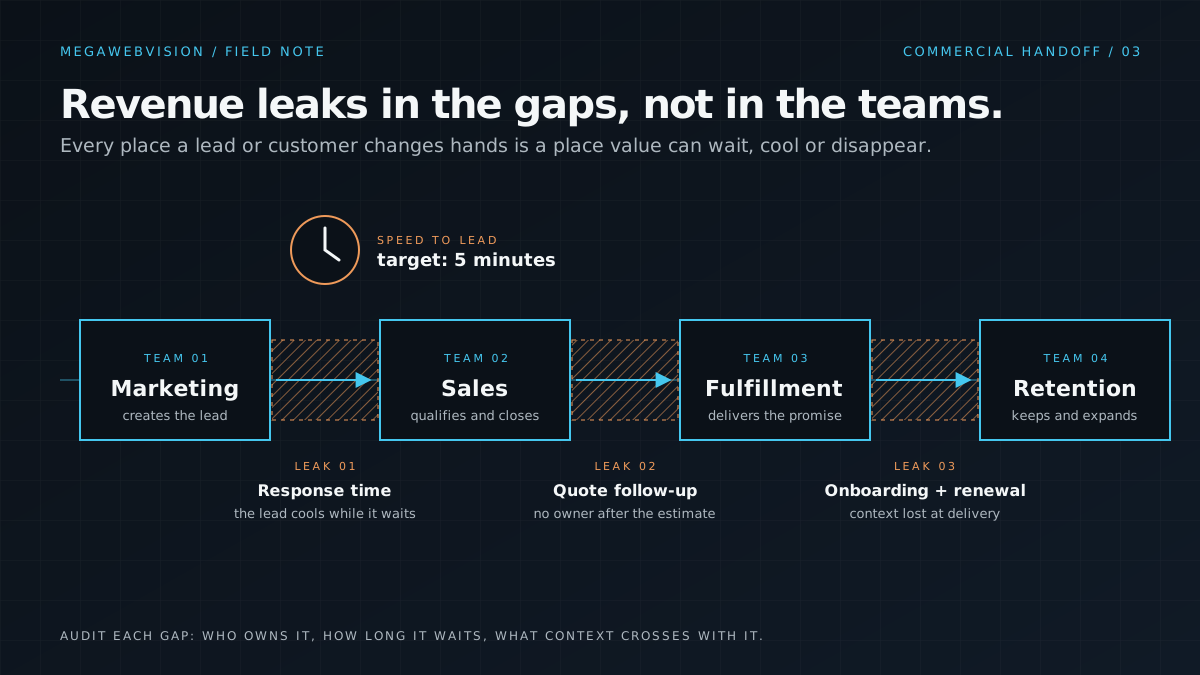
The Three Handoffs Every Service Business Has
Every service business, regardless of size, moves customers through at least three handoffs. Each one is a point where responsibility changes hands.
Larger businesses have more. Inside sales to field sales. Estimator to project manager. Account manager to support. Each added team adds a handoff, and each system that does not talk to the next one adds another. A CRM that does not pass a closed deal to the scheduling tool is a handoff, whether or not anyone calls it that.
The defining feature of a handoff is that it sits between two owners. The sending team considers its work done. The receiving team has not yet started. In that gap the customer belongs to nobody.
- Marketing to sales. A lead arrives from a form, a call, a referral or a campaign, and someone has to pick it up. The transfer is from a system that generates attention to a person who must act on it.
- Sales to fulfillment. A signed customer becomes a job, a project or an account. The transfer carries everything sales promised into the hands of the people who must deliver it.
- Fulfillment to retention. A completed job becomes a relationship. The transfer moves the customer from active delivery into renewal, repeat, referral and reactivation.
Why Handoffs Are Where Revenue Leaks
Departments are managed. Handoffs are not. A sales manager measures sales activity. A marketing manager measures lead volume. The transition between the two is measured by no one, so it is nobody's job to improve it.
Handoffs also lose information. What the customer said on the discovery call rarely reaches the crew. What the crew learned on site rarely reaches the account manager. Each loss forces the customer to repeat themselves, and each repetition lowers trust and raises the odds they leave.
Time compounds the problem. A handoff is a queue. Queues grow when arrivals outpace processing, and in most service businesses the receiving side has no visibility into the queue until it is a backlog. Leads age. Quotes go stale. Completed jobs sit without a follow-up. The revenue was earned upstream and lost in the wait.
This is why growth spending so often disappoints. Money spent on demand raises arrivals at the first handoff. If the handoff cannot absorb them, the additional leads are paid for and then lost. The campaign is blamed. The handoff was the constraint.
Speed to Lead: The Canonical Handoff
Speed to lead is the time between a lead's arrival and the first meaningful human contact. It is the marketing to sales handoff measured in minutes. It is the canonical example because it is simple, universal and expensive to get wrong.
Harvard Business Review's 2011 lead response study, which audited response times at more than two thousand US companies, found that firms contacting a lead within an hour were nearly seven times as likely to qualify it as firms that waited even one hour longer. The same study found that a substantial share of companies never responded to an inbound lead at all. The figures are widely cited because the pattern matches what most sales teams see in their own data.
The mechanism is not complicated. A prospect who fills out a form is usually still at their desk, still thinking about the problem, and often still looking at competitors. Contact within minutes reaches them in that state. Contact the next day reaches someone who has moved on or already spoken to someone else.
Speed to lead fails for ordinary reasons. Form notifications go to an inbox nobody watches. Leads route to a salesperson on vacation. The CRM assigns but does not alert. After-hours leads wait until morning, and Friday evening leads wait until Monday. None of these are strategy problems. All of them are handoff problems, and all of them are measurable from the timestamp on the lead and the timestamp on the first call.
How to Recognize a Broken Handoff
Broken handoffs produce a recognizable pattern of complaints from both sides of the gap.
The last item is decisive. A handoff without a measured duration is unmanaged by definition.
- The receiving team says it gets incomplete, late or poor-quality input.
- The sending team says its output is ignored or wasted.
- Customers repeat information they have already given.
- Records exist in two systems with different statuses.
- Response and start times vary widely with no stated standard.
- Nobody can produce a number for how long the transition takes.
The Handoff Audit: A Method
A handoff audit can be completed in a few weeks using timestamps that already exist in the business's systems. The steps below produce a map of every handoff, its owner, its duration and its leakage.
- Inventory every handoff. Walk the customer's path from first contact to renewal and list each point where ownership changes between people, teams or systems. Include the ones that exist only in email.
- Assign an owner to each. Not a department, a person. If two people claim it, or none do, record that as a finding.
- Define the trigger and the time standard. What event starts the handoff, and how long should it take? Where no standard exists, propose one and note that it was absent.
- Measure actual duration from system timestamps. Lead created to first contact. Deal closed to job scheduled. Job completed to follow-up sent. Use medians and the slowest ten percent, because averages hide the leads that waited days.
- Measure leakage. Count the records that entered the handoff and never left it: leads never contacted, deals never scheduled, completed customers never followed up. Attach revenue to them.
- Rank handoffs by leaked revenue and fix the largest first. Usually one handoff accounts for most of the loss. Design the fix as an owner, a trigger, a standard and a record, then re-measure in thirty days.
Common Mistakes
Buying software before defining the handoff. Automation applied to an unowned handoff produces faster chaos. The owner, trigger and standard come first. The tool enforces them.
Measuring only the first handoff. Speed to lead gets attention because it is easy to measure. The sales to fulfillment and fulfillment to retention handoffs often leak more revenue, because the customers passing through them have already paid.
Solving with headcount. Adding a coordinator between two teams creates two handoffs where there was one. The better fix removes the gap rather than staffing it.
Fixing it once. Handoffs decay as people change roles, systems are updated and volume grows. A handoff that was fixed last year and not measured since is probably broken again.
How Megawebvision Works on Handoffs
Handoffs are where most of Megawebvision's conversion and retention work lands, because the growth constraint diagnostic so often finds the limit in a gap rather than a department. The firm's conversion and CRM work defines owners, triggers and time standards, and builds the record that proves each handoff happened. Follow-up and retention systems cover the later handoffs, where paid customers are most often lost. Where volume or hours exceed what a team can cover, governed AI operations handle first response and routing under rules the owner has set, so no lead waits for Monday.
Questions leaders ask
What is a good speed to lead target?
Minutes, not hours. For inbound leads during business hours, first meaningful contact within five minutes is a common standard in sales operations, and within one hour is the point past which the Harvard Business Review study found qualification odds fall sharply. After hours, an immediate automated acknowledgment followed by human contact at the start of the next business day is the practical floor.
Are handoffs a people problem or a systems problem?
Usually both, and the order matters. A handoff needs an owner, a trigger, a time standard and a record. The first three are decisions people make. The record is what a system provides. Fixing the system without the decisions produces automated confusion. Making the decisions without the system produces a standard nobody can verify. Do the decisions first and the system second.
How many handoffs does a typical mid-market service business have?
Between five and fifteen once system-to-system transfers are counted. Most owners list three when asked and discover the rest during an audit. The ones discovered late tend to be the ones leaking most, because they have never been named, owned or measured. Email-only handoffs are the most common category of the undiscovered kind.
Which handoff should be fixed first?
The one leaking the most revenue, which the audit identifies by attaching value to the records that entered a handoff and never left. In businesses with strong demand and weak follow-up, that is usually marketing to sales. In businesses with long customer lifetimes, it is often fulfillment to retention, because a lost repeat customer costs far more than a lost lead.
Can AI handle commercial handoffs?
AI can handle the mechanical parts well: acknowledging a lead in seconds, routing it by rule, transferring records between systems and flagging anything that has aged past standard. It should not decide ownership or set standards, and it should operate under rules the owner has approved, with a log of what it did. Governed this way, it removes the waiting from a handoff without removing accountability.