
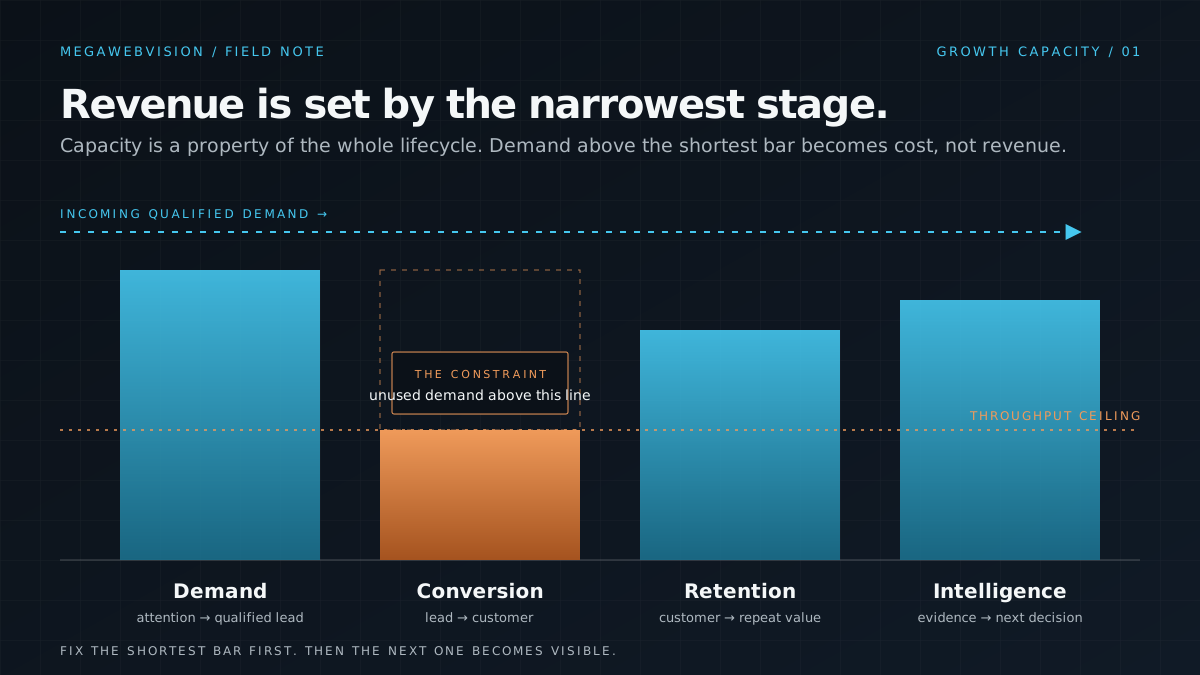
Growth capacity is a business's ability to take on more qualified demand and turn it into retained revenue without operating cost rising at the same rate. It is a property of the whole customer lifecycle, not of the marketing department. A company has growth capacity when it can generate demand, convert it, deliver on it and keep the customer, with each stage able to absorb more volume than the stage before it sends. When any one stage cannot, growth stalls at that point.
Capacity Is a Property of the Whole Business
Most owners describe growth as a demand problem. More leads, more calls, more quotes. That framing is incomplete. Demand is an input. Growth capacity is the ability of the business to absorb that input and turn it into revenue that stays. A company with strong demand and weak capacity does not grow. It gets busy, then it gets sloppy, then it gets expensive.
The useful test is the cost line. If revenue rises ten percent and operating cost rises ten percent, the business has added volume, not capacity. It has bought growth at cost. Capacity shows up when revenue rises faster than the cost of producing it. That gap is where margin, owner time and reinvestment come from.
Capacity is also finite at any given moment. Every service business has a ceiling set by its slowest stage. The ceiling moves when that stage moves. Until then, adding demand above the ceiling produces waste: unanswered leads, slow quotes, missed follow-up, overloaded crews and quiet churn.
The Four Lifecycle Stages
Megawebvision maps capacity across four stages of the customer lifecycle. Each stage has its own inputs, its own throughput and its own failure mode. Growth is limited by whichever stage has the least capacity relative to what the stage before it sends.
The stages are sequential for the customer and simultaneous for the business. A company can be starved at demand and overloaded at conversion in the same month. That is why capacity has to be measured per stage, not as one number.
- Demand. The ability to generate qualified attention at an acceptable cost. Search, paid media, referrals, partnerships and reputation all feed this stage. Its failure mode is volume that is too low, or too poorly qualified to be worth the cost of handling.
- Conversion. The ability to turn qualified demand into signed customers. Speed to lead, qualification, quoting, follow-up and closing live here. Its failure mode is leads that are paid for and then lost through slow or inconsistent handling.
- Retention. The ability to deliver, keep and grow the customer after the first sale. Onboarding, service quality, renewals, reactivation and referrals live here. Its failure mode is a bucket that leaks as fast as it fills.
- Customer intelligence. The ability to see what is happening across the other three stages and act on it. CRM hygiene, attribution, reporting and feedback loops live here. Its failure mode is decisions made on memory instead of evidence.
Why Capacity Decides Whether Growth Pays
Eliyahu Goldratt's Theory of Constraints, set out in his 1984 book The Goal, makes a point that applies directly to service businesses. The throughput of a system is set by its constraint. Improving anything other than the constraint does not raise throughput. It raises inventory and cost.
In a service business, inventory is leads waiting for a call, quotes waiting for follow-up, jobs waiting for a crew and customers waiting for a renewal conversation. Every one of those queues costs money and erodes trust. Spending more on demand while a queue grows at conversion is the most common way owners buy growth that never arrives.
Capacity also protects the owner. In many mid-market service businesses the founder is the hidden constraint. Every quote, every escalation and every hiring decision routes through one person. Revenue stops where that person's week ends. Building capacity means moving those decisions into systems and roles that can carry more volume.
How Capacity Breaks
Capacity rarely breaks loudly. It degrades. The signs are visible in operating data months before they show in the profit and loss statement.
Each of these is a stage sending more than the next stage can absorb. The break is at the receiving stage, not at the sending one. That distinction matters, because the instinct is to fix the loudest symptom. Cutting ad spend because sales is overloaded does not repair sales capacity. It hides the break for a quarter.
- Lead response time lengthens as lead volume rises.
- Close rate falls in the same quarter marketing spend increases.
- Quotes go out later, and a growing share are never followed up.
- Delivery quality complaints rise after a hiring push.
- Repeat and referral revenue flatten while new customer revenue grows.
- Reports arrive late, disagree with each other, or stop arriving.
- The owner's calendar fills with work that used to be delegated.
The Capacity Ledger: A Method for Measuring It
Growth capacity can be measured with data most service businesses already have. The method below takes a few weeks with a CRM export, a job or project log and a cost breakdown by function.
- Set a baseline volume per stage for the last twelve months. Qualified leads for demand, signed customers for conversion, active customers at twelve months for retention, and the share of records with complete data for customer intelligence.
- Calculate throughput ratios between stages. Lead to customer, customer to retained customer, retained customer to referral or repeat. Track them monthly, not annually, so you can see where they move.
- Assign operating cost to each stage. Marketing spend and salaries to demand, sales compensation and tools to conversion, delivery and account management to retention, systems and reporting to intelligence.
- Compute cost per unit of throughput for each stage and plot it against volume. A stage with capacity holds or improves its unit cost as volume rises. A stage at its ceiling shows unit cost climbing with volume.
- Model a twenty percent increase in demand. Ask which stage would degrade first, based on the ratios and unit costs already observed. That stage is the current limit on growth capacity.
- Record the ledger, act on the limiting stage, and re-measure each quarter. Capacity is not fixed. Once one stage is raised, the limit moves to another.
Common Mistakes
Measuring capacity as a single number. A blended cost per acquisition hides which stage is failing and often points investment at the wrong one.
Adding demand before conversion can absorb it. This is the most expensive mistake because the waste compounds. Each unhandled lead is paid for twice: once to acquire it and once in the reputation cost of ignoring it.
Confusing headcount with capacity. Hiring raises volume only if the process around the hire is stable. Adding a salesperson to a broken follow-up system adds another person losing leads.
Treating customer intelligence as optional. Without reliable data across the stages, every capacity decision is a guess. Businesses that skip this stage tend to fix the same problem several times.
How Megawebvision Uses Growth Capacity
Growth capacity is the frame behind every engagement. Before recommending a channel, a hire or a system, Megawebvision runs a growth constraint diagnostic to identify which lifecycle stage currently limits revenue. The work that follows is scoped to that stage, whether it is search and paid media for demand, conversion and CRM systems, follow-up and retention systems, or governed AI operations for customer intelligence. Only the capabilities the evidence requires are activated, and the ledger is re-measured as the constraint moves.
Questions leaders ask
Is growth capacity the same as scalability?
They overlap but are not identical. Scalability usually describes whether a product or system can handle more volume at all. Growth capacity is narrower and commercial. It asks whether the business can take on more qualified demand and keep the resulting revenue without cost rising at the same rate. A scalable system inside a business with a broken handoff still has low growth capacity.
Can a business have too much growth capacity?
Yes, in the sense of paying for capacity it does not use. A sales team sized for twice the current lead flow is idle cost. The goal is balance across the four stages, with each stage able to absorb slightly more than the previous one sends. Excess capacity in one stage is a signal to invest in the stage that feeds it.
How often should growth capacity be measured?
Quarterly is a practical cadence for most mid-market service businesses. Monthly tracking of the throughput ratios between stages is worth doing because those ratios move first. A full ledger with cost per stage takes more effort and changes more slowly. Re-measure sooner after any material change, such as a new channel, a hiring wave or a CRM migration.
Which stage is most often the limit?
In established service businesses, conversion and retention limit growth more often than demand does. Many owners have spent years on lead generation and comparatively little on what happens in the first hour after a lead arrives or the first ninety days after a sale. Customer intelligence is the most common hidden limit, because its failure is silent.
Does growth capacity apply to businesses under a few million in revenue?
It applies at any size, but the constraint tends to differ. Smaller businesses are usually limited by the owner's time at the conversion stage. Larger businesses are more often limited by handoffs between teams and by weak customer intelligence. The measurement method is the same. The ledger is just shorter for a smaller company.