
Governed AI operations is the practice of running AI agents and automations that do real marketing and operations work inside explicit boundaries. Each agent has a named human owner, a written scope, credentials limited to that scope, an approval gate before any external action, and an audit log of what it did and why. Consequential decisions stay with people. Outputs are read back against the source system and verified before anyone relies on them. The AI does the work. The business keeps control.
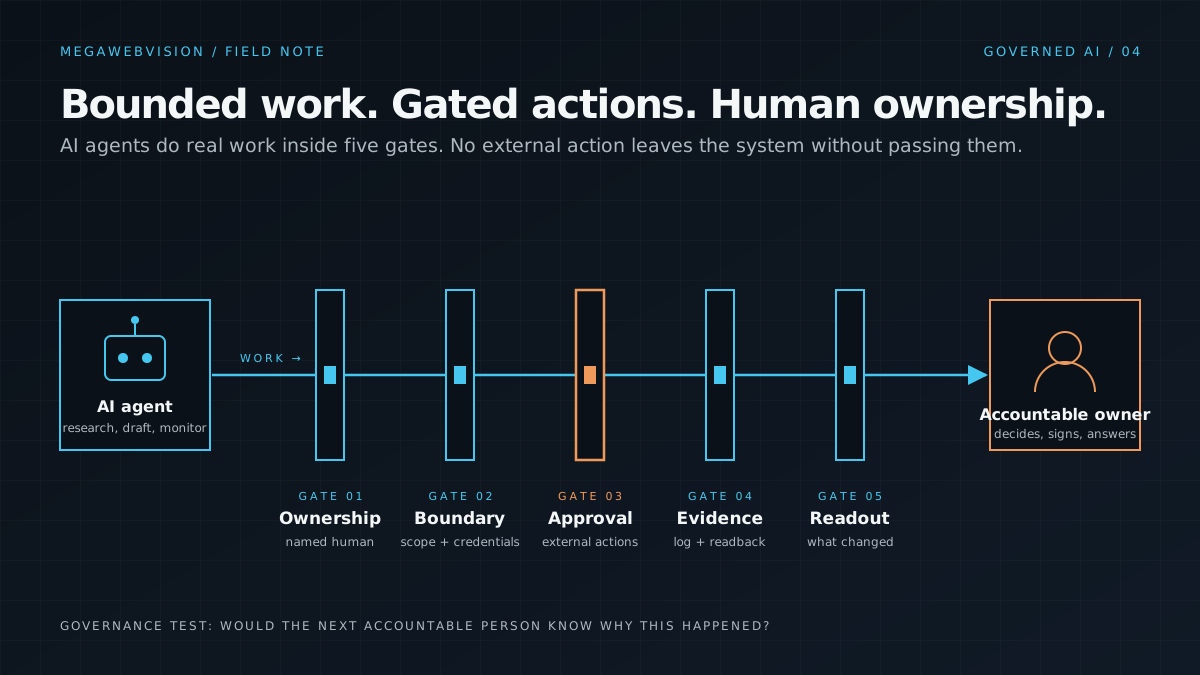
What governed AI operations includes
An AI agent in operations is software that reads context, decides on a next step, and takes it. It might draft a follow-up email, update a CRM record, pause an ad group, or prepare a weekly report. That is real work with real consequences. Governance is the set of rules that decide which of those steps the agent can take alone, which need a person to approve, and how every step is recorded.
Five elements make the practice governed rather than merely automated. Ownership: a named person is accountable for each agent. Boundary: the agent has a written scope and credentials that match it, nothing wider. Approval: any action that touches a customer, spends money, or changes a live system waits for a human yes. Evidence: every action is logged with its inputs and its result. Readback: outputs are verified against the source before they inform a decision.
Remove any one of these and you have automation with a blind spot. Keep all five and you have a system a CEO can defend to a board, an auditor, or a customer.
Why ungoverned automation hides risk
Ungoverned automation fails quietly. A workflow that emails the wrong segment does not raise an alarm. It sends. An agent with broad CRM access that misreads a field does not stop. It writes. The damage shows up weeks later as a complaint, a compliance question, or a revenue number nobody can explain.
The risk compounds because AI agents act at machine speed and machine volume. A person making a bad judgment call affects one account. An agent making the same call affects every account that matches the rule. Speed is the point of automation. Without boundaries, speed is also the exposure.
There is a second, quieter cost. When nobody can say what the system did, nobody can improve it. Reports get trusted or ignored on instinct. Owners lose the ability to ask why a number moved. Governance restores that ability by making every action traceable. These are the signs that a business is running ungoverned automation today.
- No one can name the person responsible for a given automation.
- Credentials are shared, broad, or stored inside the tool itself.
- Agents can send, post, publish, or spend without a human approving the specific action.
- The only record of what happened is the outcome, not the steps that produced it.
- Reports are accepted without being checked against the source system.
- A workflow has been running for months and nobody remembers what it does.
The Five-Gate Governance Model
Governance works when it is a short list of gates that every agent passes through, in order, before it runs and every time its scope changes. This is the model.
- Assign ownership. Name one person who is accountable for the agent's behavior and its output. Not a team. A person. That person approves scope changes and answers when something goes wrong.
- Draw the boundary. Write down what the agent may read, what it may change, and what it may never touch. Issue credentials that enforce exactly that scope. If the agent only needs to read a pipeline, it gets read access and nothing more.
- Set the approval gate. Classify actions as internal or external. Internal actions, such as drafting, scoring, or preparing a summary, can run freely. External actions, such as sending, publishing, spending, or changing a customer record, wait for explicit human approval. The approval names the action, the target, and the reason.
- Capture evidence. Log every action with its timestamp, its inputs, the decision it made, and the result. The log is written by the system, not by the agent describing itself. It must be readable by someone who did not build it.
- Read out and verify. Before any output informs a decision, compare it to the source. If the agent says a campaign spent a certain amount, check the platform. If it says a lead was contacted, check the record. Readback is what turns an agent's claim into a fact.
Where AI extends a growth system, and where it stops
AI is strong at bounded, repeatable, high-volume work with a clear definition of done. In a growth system that includes enriching and scoring inbound leads, drafting first-response and follow-up messages for approval, monitoring paid media for anomalies, assembling weekly performance readouts, reconciling CRM data against ad platform data, and flagging pipeline records that have gone stale.
AI is weak at the decisions that set the direction of the system. Which customer segment to pursue. Whether to raise price. When to cut a channel that used to work. How to interpret a quarter where every metric moved at once. These are judgment calls that depend on context the agent cannot see: the owner's risk tolerance, the team's capacity, the competitive situation, and the history behind each number.
The rule is direct. Agents execute inside a strategy. They do not set it. Senior judgment owns the commercial question. AI owns the work that follows from the answer. When a vendor proposes an agent that decides strategy, that is a boundary problem, not a capability.
Common mistakes
Most failures in AI operations come from a small number of avoidable decisions made early, usually for convenience.
- Treating a demo as proof. An agent that performs well on a clean sample can behave differently on live data with edge cases. Test on real records with approval gates on.
- Granting broad credentials for convenience. One admin token shared across agents means one failure exposes everything.
- Letting the agent grade its own work. Self-reported success is not evidence. Readback against the source is.
- Automating a broken process. If follow-up is inconsistent because the offer is unclear, an agent will send unclear follow-up faster.
- Skipping the owner. A shared inbox is not an owner. When nobody is accountable, nobody notices drift.
- Approving categories instead of actions. Blanket approval for all outbound email is not a gate. Approval is per action, or per tightly defined batch.
What to ask a vendor
Any vendor selling AI agents for marketing or operations should be able to answer these without hesitation.
- Who owns each agent on our side, and how is that recorded?
- What exactly can the agent read, change, and send? Show the credential scope.
- Which actions require a human approval, and what does the approval record contain?
- Where is the audit log, who can read it, and can it be exported?
- How is output verified against the source system before it reaches a report?
- What happens when the agent is uncertain? Does it stop, ask, or guess?
- How do we revoke access in one step?
How Megawebvision applies it
Megawebvision runs governed AI as one capability inside a growth system, not as the system. Its internal operating layer, CHIEF, runs AI agents on bounded marketing and operations work: follow-up drafting, CRM hygiene, media monitoring, reporting. Every external action passes an approval gate. Every action is logged. Every agent has a named owner. Readback against the live platform is required before a number reaches a client.
The agents are activated only when the constraint diagnosis shows that capacity, not strategy, is the limit. Where senior judgment is the missing piece, the answer is leadership, not automation.
Questions leaders ask
Is governed AI operations the same as marketing automation?
No. Marketing automation follows fixed rules you configure in advance, such as send this email three days after a form fill. Governed AI operations covers agents that interpret context and choose actions, which is why governance matters more. The agent can do more, so its boundaries, approvals, and logs need to be explicit rather than assumed.
Does an approval gate slow everything down?
It slows down external actions, which is the point. Internal work such as drafting, scoring, and summarizing runs without waiting. Approvals for outbound messages or spend changes are batched and take minutes per day for a named owner. The alternative is finding the error after a customer or a bank statement finds it first.
What should an audit log contain?
Timestamp, the agent that acted, the input it read, the decision it made, the action taken, the target of the action, the result, and the approving person where one was required. It should be written by the system, not summarized by the agent, and readable by someone who did not build it. If a log cannot answer why a record changed, it is not an audit log.
Can a small team run governed AI operations?
Yes, and small teams benefit most because one bad automation can consume a large share of their capacity. The model scales down. One owner, one written scope, one approval routine, one log, one readback habit. Most of it is discipline, not tooling. The tooling only has to make the discipline easy to keep.
Which decisions should never be delegated to an AI agent?
Anything that sets direction or carries a consequence the business cannot easily reverse. Pricing. Segment choice. Cutting or launching a channel. Contract terms. Communication during a complaint or a crisis. Hiring. An agent can prepare the analysis for each of these. A person makes the call and owns it.