
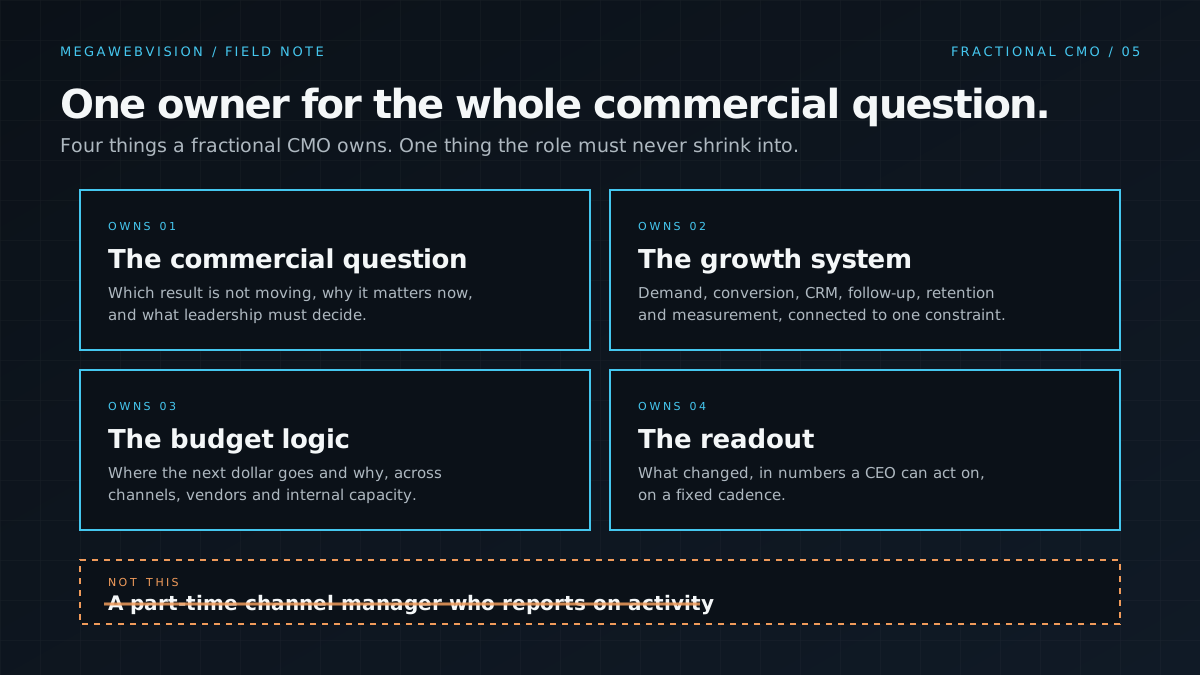
A fractional CMO is a senior marketing executive who leads a company's growth function on a part-time, ongoing basis instead of as a full-time employee. For a mid-market or established service business, the role owns the commercial question, the design of the growth system, the logic behind the marketing budget, and the readout of results to the owner or CEO. The fractional CMO directs agencies, in-house staff, and tools. They are accountable for revenue outcomes, not for running a channel.
Why the role exists in mid-market service businesses
Most established service businesses reach a point where marketing has outgrown its structure. There is a coordinator or a small in-house team. There are two or three agencies, each reporting on its own channel. There is spend, activity, and a monthly deck. What is missing is one person who is accountable for whether all of it produces revenue.
A full-time chief marketing officer is often the wrong fix. The salary is hard to justify below a certain scale. Candidates with real experience want a bigger stage. And the actual workload of senior decisions is a fraction of a week. The rest is execution, which the team and the agencies already do.
The fractional CMO fills that gap. Senior judgment on a part-time basis, with continuity, for a fee that fits the business. The role is common in North American mid-market companies in professional services, healthcare, home services, construction, manufacturing, and business-to-business services. Anywhere the sale is considered, the customer lifetime is long, and the handoff from marketing to sales to delivery decides the outcome.
What a fractional CMO owns, and what they are not
The role has four responsibilities. If any of them is missing from the engagement, you have hired something else.
First, the commercial question. Which customers, at what price, through which path, and why. The fractional CMO forces this to be answered explicitly and keeps every activity tied to the answer. Second, the growth system. The full path from demand to conversion to retention, with named owners at each handoff. Not a channel plan. A system design that shows where revenue is limited and what changes it.
Third, the budget logic. Where money goes, in what proportion, based on which evidence, and what result would cause it to move. The owner should be able to explain the budget in two sentences after hearing it once. Fourth, the readout. A regular, plain-language account of what happened, what it means, and what changes next. Numbers reconciled to the source. No agency slides.
A fractional CMO is not a part-time channel manager. If the person spends most of their hours inside an ad account, writing posts, or building automations, the business is paying senior rates for execution. It is not an agency salesperson placed inside the company to keep retainers alive. It is not a dashboard builder. And it is not a strategist who hands over a document and leaves.
The role is accountable for outcomes. That means it stays through execution, directs the people and vendors doing the work, and owns the result. A title without that accountability is a consultant, and should be priced like one.
When you need one, versus an agency or a full-time hire
An agency is the right choice when the strategy is clear, the constraint is known, and the missing piece is skilled execution in one or two channels. Agencies are good at doing. They are structurally poor at deciding whether their channel should exist, because that decision affects their own revenue.
A fractional CMO is the right choice when the business cannot say with confidence what limits revenue, when several agencies or team members produce activity without a shared plan, when the owner is the de facto head of marketing and has no time for it, or when a large spend decision is coming and nobody senior is accountable for it.
A full-time CMO becomes the right choice when the marketing function is large enough that leading it is a full week's work, usually with several direct reports and multiple product lines or markets. Many businesses use a fractional CMO to build the system, then hire full-time once the role has a defined shape.
Signs you need one now: revenue has been flat while marketing spend has grown, sales blames lead quality and marketing blames follow-up, agency reports do not reconcile with the CRM, or the owner cannot say where the next ten customers will come from.
The Diagnose, Design, Direct, Read Out cycle
A sound fractional CMO engagement follows a repeatable cycle. The first pass takes roughly ninety days. After that it runs continuously at a lighter cadence.
- Diagnose. Weeks one to three. Audit the customer lifecycle from first contact to renewal. Reconcile ad platform data, CRM data, and revenue. Interview sales and delivery. Identify the single stage where capacity breaks and revenue is limited.
- Design. Weeks three to six. Write the commercial question and its answer. Draw the growth system with owners at each handoff. Set the budget logic and the metrics that will move it. Decide which capabilities to activate and which to leave alone.
- Direct. Weeks six to twelve. Brief agencies and staff against the design. Replace, renegotiate, or refocus vendors that do not fit. Install measurement at each handoff. Approve spend. Remove work that does not serve the constraint.
- Read out. Week twelve, then monthly. Report what changed, what it cost, what it returned, and what the next decision is. State plainly what did not work. Reset the diagnosis if the constraint has moved.
How engagements are priced and how to judge one after 90 days
Time commitment usually falls between one and two days per week, front-loaded in the diagnosis and design phases. Engagements are typically a fixed monthly fee with a defined scope and a notice period. Be wary of engagements priced as a percentage of media spend. That aligns the CMO with spending, not with revenue.
Do not judge a fractional CMO at ninety days on revenue alone. Sales cycles in service businesses are often longer than that. Judge on whether the system now exists and whether the business can see itself clearly. These are the tests.
- You can state, in one paragraph, what limits revenue and why. Before the engagement you could not.
- There is a written growth system with a named owner for each handoff.
- The budget has a stated logic and a stated trigger for change.
- Agency and CRM numbers reconcile, or the gap is known and being closed.
- At least one activity has been stopped because it did not serve the constraint.
- Sales and marketing describe the same funnel with the same numbers.
- The readout is plain enough that the owner can repeat it to the bank or the board without help.
Common mistakes
The hiring errors repeat across industries. Each one turns a leadership role into something cheaper and less useful.
- Hiring for channel expertise instead of commercial judgment. The person who ran paid search at a large company may not know how to decide whether paid search belongs in your business.
- Letting the fractional CMO also sell you their agency. The conflict is structural, not personal.
- Skipping the diagnosis because the owner already knows the problem. Owners are usually right about symptoms and often wrong about the constraint.
- Measuring the role on activity. Campaigns launched and posts published are not the job.
- Giving the role no authority over vendors and budget. Accountability without authority produces reports, not results.
- Keeping the engagement going after the system is built and stable, when a full-time hire or a lighter advisory cadence would cost less.
How Megawebvision approaches growth leadership
Megawebvision provides fractional CMO leadership as one capability inside a broader growth system. The engagement starts with a constraint diagnosis across demand, conversion, retention, and customer intelligence. Leadership is activated when the evidence shows the business lacks senior direction, not as a default.
The role owns the commercial question, the system design, the budget logic, and the readout. Execution capabilities, including search and paid media, conversion and CRM, retention systems, and governed AI operations, are added only where the diagnosis requires them. The founder leads the engagement directly.
Questions leaders ask
How much does a fractional CMO cost?
Fees vary with scope, seniority, and time commitment, and there is no reliable public benchmark. A useful frame is that one to two days a week of senior leadership should cost a fraction of a full-time executive's fully loaded compensation, and should be priced as a fixed monthly fee. Avoid pricing tied to media spend, which rewards spending rather than results.
How long should a fractional CMO engagement last?
Long enough to diagnose, design, direct, and read out at least twice. In practice that is six to twelve months for the first cycle. After that, many businesses keep a lighter advisory cadence, hire full-time once the role has a defined shape, or pause once the growth system runs without senior intervention. An engagement with no defined end is a warning sign.
Can a fractional CMO manage our existing agencies?
Yes, and that is one of the most valuable parts of the role. The fractional CMO writes the brief, sets the metrics, reviews the work, and reconciles agency reporting against the CRM. Agencies perform better with a senior client-side counterpart. Some will resist the scrutiny. That is useful information about the agency.
What is the difference between a fractional CMO and a marketing consultant?
A consultant advises and leaves. A fractional CMO is accountable for outcomes and stays through execution, directing staff, agencies, and budget. The consultant delivers a document. The fractional CMO delivers a working growth system and a readout the owner can act on. The distinction is ownership, not hours.
Does a fractional CMO need experience in our industry?
It helps less than owners expect. What matters is experience with businesses of similar scale, sales cycle, and customer lifetime, and the ability to diagnose which lifecycle stage limits revenue. Sector knowledge can be learned in weeks. Commercial judgment cannot. Be cautious of candidates whose entire career sits inside one channel or one industry.