
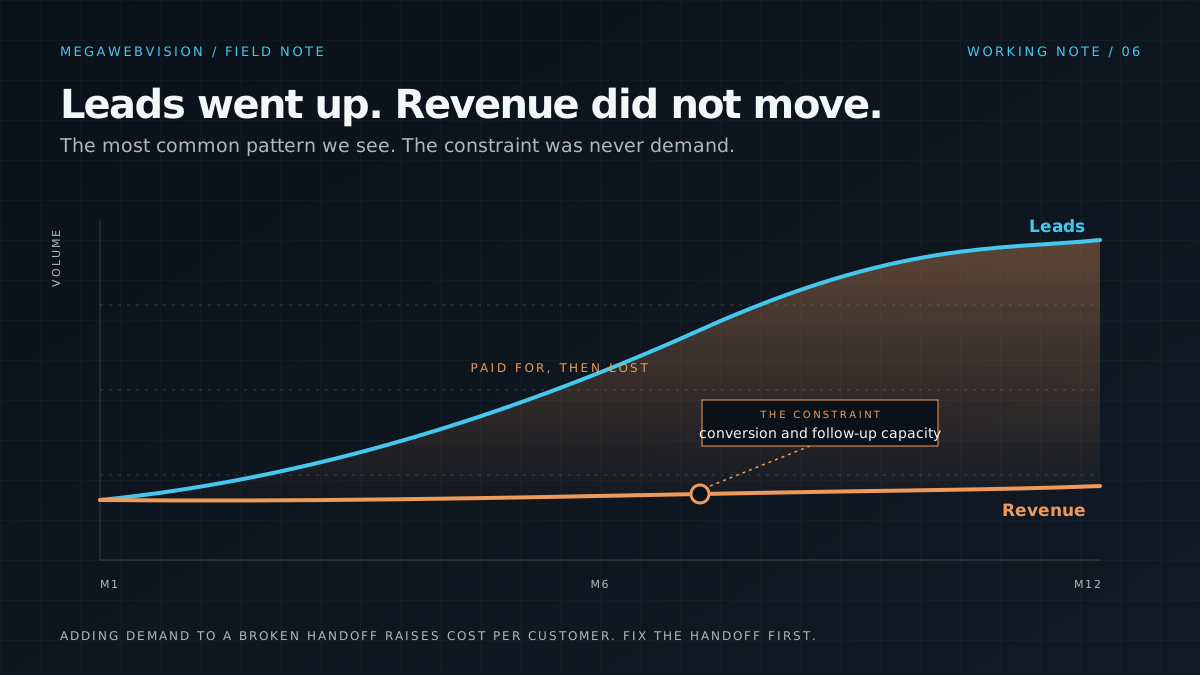
The most common growth failure in established service businesses is buying more demand when demand was not the limit. Leads rise. Revenue stays flat. Cost per customer climbs. The constraint was somewhere after the lead: speed to contact, follow-up discipline, sales capacity, or the ability to deliver the work. Adding volume to a broken handoff raises cost without raising revenue. Find the handoff that leaks, measure it, and fix it before spending another dollar on demand.
The pattern
The story is almost always the same. Revenue has been flat for a few quarters. The owner concludes the business needs more customers, and more customers means more leads. Budget goes to search, paid social, or a new agency. Lead volume rises, sometimes sharply. Six months later, revenue has barely moved. Cost per customer has gone up. The agency reports success. The owner is confused and out of patience.
Nobody lied. The agency delivered leads. The problem is that leads were never the limit. Somewhere between the form fill and the signed contract, or between the signed contract and the delivered work, the business could not process what it already had. Adding volume did not change that. It made it worse.
How to tell where the leak is
Every customer passes through a sequence of handoffs. At each one, some drop. The way to find the constraint is to measure the drop and the delay at each handoff, then look for the stage where the numbers get worse when volume goes up. That is the capacity break.
- Lead to first contact. Measure the share of leads contacted and the median time to first contact. Speed matters more than most owners believe. Same-hour contact and next-day contact produce very different results.
- First contact to qualified conversation. Measure the share that reach a real conversation with someone who can advance the sale, and how many attempts it took.
- Qualified conversation to proposal or quote. Measure the share that receive one and the days it took to produce it.
- Proposal to close. Measure win rate and cycle time. Watch for proposals that go quiet with no recorded follow-up.
- Close to delivery start. Measure the delay before work begins and the share of signed customers who wait longer than promised.
- Delivery to repeat or referral. Measure retention, repeat purchase, and referral rate. A leak here means demand is being spent to replace customers who should have stayed.
Why more demand raises cost per customer
Run one test with the handoff numbers. Compare each ratio in a low-volume month to the same ratio in a high-volume month. A stage that holds its ratio when volume rises has capacity. A stage whose ratio falls when volume rises is the constraint. In most flat-revenue businesses, that stage is first contact, follow-up, or delivery start. It is rarely lead volume.
The arithmetic is unforgiving. Suppose a business generates one hundred leads a month and its sales process can properly work sixty of them. Forty go cold for lack of follow-up. Now the business doubles lead spend and gets two hundred leads. Capacity has not changed. Sixty are still worked well. The other one hundred forty go cold. Customers closed stay roughly the same. Spend has doubled. Cost per customer has doubled.
It gets worse in practice. The overwhelmed team works every lead a little less well. Response times stretch. Sequences get skipped. The sixty become forty-five. Closed customers fall. The agency, watching cost per lead hold steady, reports a healthy campaign. It is. The campaign is not the problem.
Leads contacted late or never also form an opinion of the business, and some share it. The numbers in this example are illustrative, not measured. The shape is what matters. Volume into a fixed-capacity stage produces a flat customer count and a rising cost.
What to fix first
Fix in order of position in the chain, working backward from the money. A leak close to revenue costs more per lost customer than a leak at the top, and fixing it improves the return on every lead you already pay for.
- Delivery capacity. If signed customers wait or churn because the business cannot deliver, stop buying demand until delivery is stable. Every lead you add is a future disappointed customer.
- Follow-up discipline. Install a defined sequence for every lead: who contacts, within what time, how many attempts, through which channels, and what gets recorded. Make it visible in the CRM. Assign an owner. Measure it weekly. This is the highest-return fix in most service businesses and it costs almost nothing in media.
- Speed to first contact. Route leads to a person, or to a governed automation under human approval, that responds within minutes during business hours and acknowledges outside them. Measure median time to contact and treat any increase as an incident.
- Conversion mechanics. Only after follow-up is reliable, examine the offer, the proposal process, the pricing presentation, and the sales conversation. Improvements here compound because they act on every lead.
- Demand. Last. Once each handoff holds its ratio under load, more demand converts into more revenue at a predictable cost. Now buying leads is a rational decision with a known return.
How Megawebvision approaches it
The order feels backward to owners who have been told for years that growth starts at the top of the funnel. It does not. Growth starts where capacity breaks. Fix that stage and the demand you already have starts producing revenue.
Megawebvision begins every engagement with a constraint diagnosis across the customer lifecycle: demand, conversion, retention, and customer intelligence. The diagnosis measures each handoff and identifies the stage where capacity breaks. Only then are capabilities activated. When the constraint is follow-up, the work is CRM and follow-up systems, often with governed AI agents handling first response and sequence discipline under human approval. When the constraint is delivery, the recommendation is to pause demand spend. Buying leads is proposed only when the evidence shows that demand is the limit.
Questions leaders ask
How do I know if the problem is lead quality rather than follow-up?
Look at the records. If leads are contacted quickly, worked through a full sequence, and still do not convert, quality or targeting is the issue. If a large share of leads show no contact, one attempt, or a first response measured in days, the problem is follow-up. Most businesses that blame lead quality have never measured time to first contact.
Should I pause my ad spend while fixing the handoff?
Usually reduce rather than pause, unless delivery is the constraint. Keep enough volume to measure the handoff under realistic load and to protect the team's pipeline. Move the released budget into the fix: CRM configuration, follow-up staffing or automation, and measurement. Restore spend once each stage holds its ratio when volume rises.
What should a weekly handoff report contain?
For each stage: volume in, volume out, the ratio, the median delay, and the change versus the prior period. One page. Owners named for each stage. A short note on any stage whose ratio fell. If the report takes more than a few minutes to read, it is a dashboard, not a readout. The purpose is to make the constraint visible every week.