
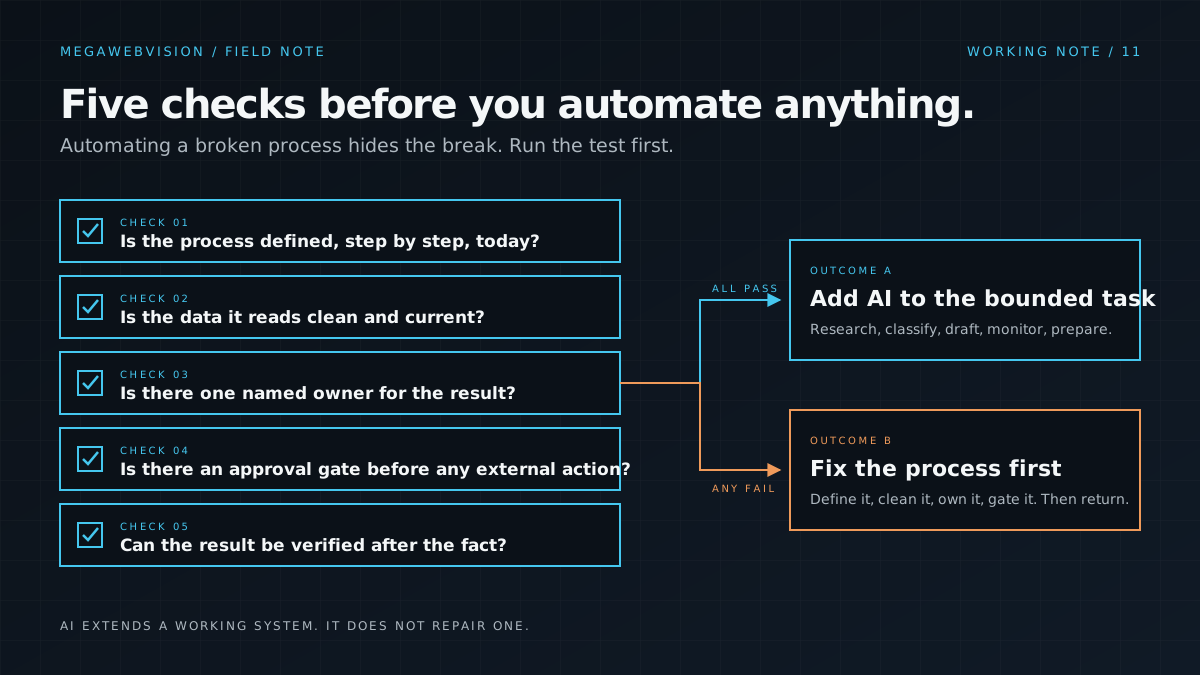
AI belongs in marketing operations when it is given a bounded task inside a process that already works. The test has five parts: the process is defined, the data is clean, someone owns the outcome, there is an approval gate before anything reaches a customer, and the result can be verified. If any part fails, adding AI accelerates the failure. Fix the process first. Then automate the pieces that pass.
Start with the process, not the tool
Most owners are being sold AI as a way to do more with the same team. Sometimes it is. But AI does not add judgment to a process. It adds speed and volume to whatever the process already does. If your follow-up is inconsistent, AI makes it inconsistently faster. If your lead data is dirty, AI writes confident messages to the wrong people.
The useful question is narrower. Which tasks in marketing operations are defined well enough, and bounded tightly enough, that a system can do them with a person checking the output. Those tasks exist in most businesses. They are rarely the ones in the sales pitch.
The readiness test
Apply these five questions to any task before automating it. All five have to pass. A task that fails one is not ready, however attractive the demo looked.
- Is the process defined? Can you write down the inputs, the steps and the output on one page, and would two people following it produce the same result? If it lives in someone's head, it is not ready.
- Is the data clean? Are the fields the task depends on populated, current and consistent? Check a sample of 50 records by hand. If a third are wrong, the output will be wrong a third of the time and look fine.
- Is there an owner? One named person accountable for the outcome, who reviews the output, notices drift and can switch it off. A task nobody owns will run until it embarrasses you.
- Is there an approval gate? Before anything reaches a customer, changes a record of value or spends money, a person approves it. The gate can move to sampling once the task has proven itself. It cannot be skipped at the start.
- Can the result be verified? Is there a number that tells you whether the task did what it was meant to, and can you check it against the source? If you cannot tell when it is wrong, you cannot run it.
Bounded tasks that work
Drafting, not sending. A first draft of a follow-up email for a sent estimate, built from the CRM record, that the owner edits and sends. A summary of a recorded discovery call into the CRM notes field, reviewed by the rep before it is saved. A weekly draft of the pipeline readout from the CRM export, checked against the dashboard.
Classifying, with review. Tagging inbound inquiries by service line and urgency so routing is faster, with a person confirming anything outside the confident cases. Sorting form submissions into qualified, unqualified and needs a look. Flagging reviews that mention a specific complaint.
Checking, at scale. Reading every lead record created last week for missing fields and producing a list. Comparing landing page copy against the ad it is paired with and listing mismatches. Watching call transcripts for the question that keeps coming up and nobody has a page for.
Each of these has a defined input, a bounded output, an owner, a gate and a way to verify. Each saves hours a week. None of them talks to a customer without a person in the loop.
Where AI does not belong yet
Anything that reaches a customer without review. Fully automated replies to inbound leads, outbound sequences generated per lead, chat that commits to prices or appointments. The upside is small and the downside is a screenshot.
Anything that decides on money without a gate. Bid changes, budget shifts, pausing campaigns. The ad platforms already automate much of this inside their own guardrails. Adding another layer that nobody in the business understands is not governance.
Anything where the underlying process is disputed. If sales and marketing do not agree on what a qualified lead is, an AI that scores leads will settle the argument by accident and both sides will distrust it.
Anything in healthcare, finance or legal services that touches personal information without a written policy on what the system may see and store. Get the policy first.
The failure mode: automating a broken process
The typical story runs like this. A business has slow, inconsistent follow-up. Instead of fixing ownership and coverage, it buys a tool that sends AI-written messages to every lead. For two weeks it looks like progress. Then a lead replies and nobody sees it, because reply handling was never defined. A customer gets three messages after saying no. A rep stops trusting the CRM and goes back to a notebook. The tool is blamed.
The process was broken before the tool arrived. The tool made the breakage visible and fast. This is the most common way AI fails in marketing operations, and it has nothing to do with the model.
The order that works is dull. Define the process. Clean the data. Assign the owner. Run it by hand for a month so the baseline numbers exist. Then automate the bounded pieces, behind a gate, with verification, and widen the automation as the results earn it. Governed AI operations means exactly this: the automation is scoped, owned, gated and checked, and someone can say at any moment what it did and why.
Questions leaders ask
Which task should we automate first?
The one that is most repetitive, already documented, and lowest risk if it goes wrong. For most service businesses that is drafting estimate follow-ups or summarizing calls into the CRM, with a person sending or saving. Prove the readiness test on one task, then move to the next. Do not start with anything customer-facing.
Do we need a data cleanup before any of this?
You need the fields the task depends on to be clean, not the whole CRM. Pick the task, list the fields it reads, sample them by hand, and fix those. A full data project before any automation usually stalls. A narrow cleanup tied to one task usually finishes and pays for itself.
How do we know the automation is still working three months in?
Because the owner is checking a number every week. Draft acceptance rate, classification accuracy on a sample, time saved against baseline, and the count of outputs a person had to correct. When the correction rate rises, the inputs have drifted. Verification is not a launch step. It is the operating cadence.